Retirement Home Costs in India (2026): Complete Rent & Price Breakdown
How much does a luxury senior living community actually cost? Get our brutal, honest breakdown of monthly rentals, upfront deposits, hidden fees, and why the rental model saves you lakhs.
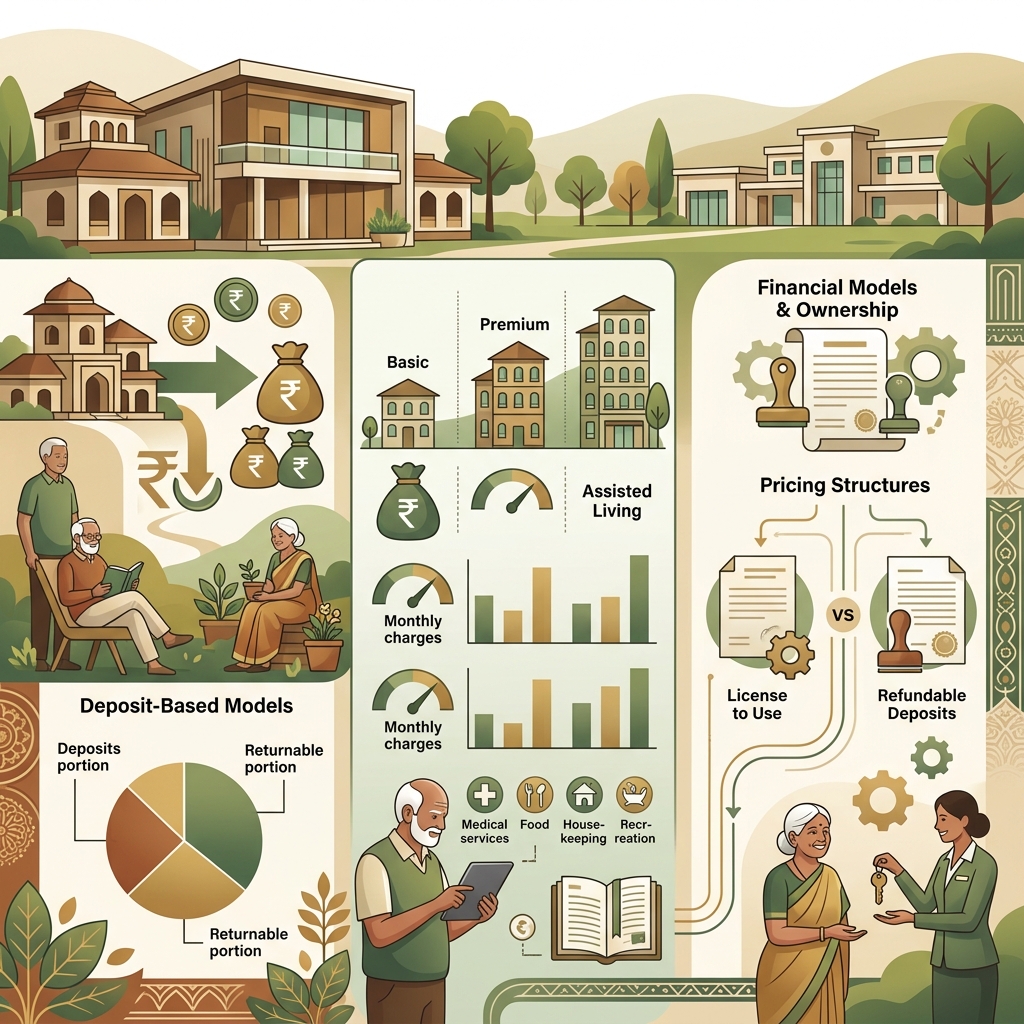
The cost of retirement homes in India ranges from ₹25,000 to over ₹1,50,000 per month depending on the location, care level, and financial model. While traditional models require locking up ₹30 Lakhs to ₹1 Crore in property purchases, modern rental models offer luxury senior living with predictable monthly rent (standard refundable deposit applies).
The cost of retirement homes in India in 2026 ranges from ₹25,000 to ₹1,50,000 per month, depending on city, care level, and what's actually included in that monthly number. Most families get confused at the shortlist stage — not because the fees are hidden, but because nobody explains what you're actually comparing.
Here's the problem: a ₹45,000 monthly fee at one community and a ₹25 lakh one-time deposit at another are not directly comparable. One locks up your capital for years. The other doesn't. Which is more expensive? That depends entirely on what you do with the money you didn't pay upfront.
This guide gives you the honest breakdown — numbers, traps, and all.
The Three Entry Models — and the One Most Families Overlook
Every senior living community operates on one of three financial frameworks. The one you choose determines how much money you actually spend over a decade.
1. Outright Purchase
You buy the unit. The campus is yours, on paper.
The numbers: ₹40 lakhs to ₹3 crores upfront, plus monthly maintenance and property taxes. The problem most people don't anticipate: if your health needs change and you need to move — or if a loved one passes — reselling a "senior-only" unit takes years, sometimes at a loss. You've bought an illiquid asset in a niche market.
2. Refundable Deposit
You pay a large lump sum upfront. When you leave (or pass away), a percentage comes back.
The numbers: ₹20 to ₹80 lakhs at entry, plus moderate monthly fees. The financial reality: that ₹50 lakh sitting in a deposit is working for the community, not for you. At a conservative 8% annual return, you're losing ₹4 lakhs every single year in opportunity cost. That's ₹40 lakhs over a decade — quietly, invisibly.
3. Monthly Rental (No Capital Lock-in)
You pay a monthly fee. Your savings stay exactly where they are.
The numbers: Zero upfront (beyond a small security deposit), one predictable monthly payment. This is the model Aran operates on. Your ₹50-60 lakhs stays invested. The returns from that corpus can offset a meaningful portion of your monthly cost.
While ownership requires significant upfront capital, the rental model allows seniors to keep their life savings earning 8-9% in senior-focused financial instruments.
| What Changes | Purchase | Refundable Deposit | Aran's Rental Model |
|---|---|---|---|
| Capital tied up | ₹40L–₹3Cr | ₹20L–₹80L | Security deposit only |
| Ability to leave | Very difficult | 3-6 month notice | Short notice, no penalty |
| What happens if needs change | Resell (difficult) | Partial refund | Just move |
| Your savings keep earning | No | No | Yes |
What Does the Monthly Fee Actually Cover?
When people see ₹45,000/month and think "that's expensive," they're usually comparing it to rent — not to rent plus groceries plus a cook plus security plus electricity plus maintenance plus medical transport plus gym membership.
Here's what a comprehensive monthly fee at a place like Aran actually replaces:
Safety you'd have to build yourself at home: RFID-based presence management that tracks whether a resident has moved in an unusual period — not to monitor, but to catch a fall before it becomes a crisis. SOS buttons. A 24/7 command center. This infrastructure costs lakhs to set up privately; here it's part of the package.
Food you'd have to manage yourself: Three wholesome, freshly prepared meals, daily, calibrated for geriatric nutrition. The hidden cost of eating well alone — groceries, a reliable cook, gas, cooking time — is higher than most families estimate.
Medical adjacency: No hospital in the building, but emergency protocols connecting with KG Hospital and Ganga Hospital — both within 20 km of the Thondamuthur campus. The cost of a medical emergency without this infrastructure is not just financial.
Why is Coimbatore 20-30% Cheaper Than Bangalore for the Same Quality?
The short answer: land and climate.
In Bangalore's senior living corridors, land costs drive up everything — the entry models, the maintenance, the monthly fees. In Thondamuthur, 12 km from the Isha Yoga Center, the same investment buys actual open space: walking paths through the Velliangiri foothills, garden courtyards, natural light. Lower land cost doesn't mean lower quality. It means your money goes further.
The climate helps too. Coimbatore's moderate year-round temperatures mean significantly lower air conditioning and heating costs compared to Chennai's summers or Hyderabad's extremes. That saving passes through to monthly fees. For a complete state-level price guide, explore our breakdown on the cost of senior living in Tamil Nadu.
Why families are choosing the Velliangiri foothills for retirementOne Family's Math
Vikram's parents moved to a Bangalore facility five years ago on a ₹55 lakh deposit. The deposit sits there. Monthly costs are ₹32,000. His parents are comfortable, but Vikram recently realized something: that ₹55 lakhs, if placed in a diversified mutual fund portfolio at 9% annual return, would have generated ₹4.95 lakhs every year — or ₹41,250 per month. Enough to cover the entire monthly cost, with change remaining.
He wasn't unhappy with the facility. He was unhappy with the math nobody had shown him at the beginning.
Families who start with the rental model keep that choice open. Explore our rental retirement homes in Coimbatore to see how luxury community living operates without capital lock-in.
What are the common hidden costs in senior living contracts?
Ask these before signing anything:
- Non-Refundable Admission Fees — Is there a one-time joining fee separate from the deposit? How much?
- Guest Stays — If your children visit for 10 days, what does that cost?
- Care Level Upgrades — If a resident needs temporary assistance (post-surgery, illness), does the monthly fee change? By how much?
- Electricity & Utility Metering — Is electricity billed transparently on actual sub-meter consumption, or are there hidden markups and arbitrary unit caps with penalty surcharges?
These aren't gotcha questions. Any reputable community will answer them clearly. If they can't, that's your answer.
Full breakdown: Senior living costs vs. aging at home — the real comparisonThe Honest Conclusion
The "cheapest" retirement option is rarely the cheapest when you account for the full picture — opportunity cost, hidden fees, the cost of a bad outcome when safety infrastructure fails, and the emotional toll of a decision made under financial pressure.
The question worth asking isn't "what can we afford?" It's "what does a well-made decision actually cost, and what does a poorly-made one cost later?"
Learn more. Inquire now about Aran Senior Living in Coimbatore.
Editorial Note
Cost data in this article is based on the Aran Research Team's direct market surveys of 15+ senior living communities across India, supplemented by publicly available industry analyses from JLL, Knight Frank, and CRISIL on residential real estate trends.
About the Author: The Aran Research Team writes about senior care, elder finance, and retirement planning in India. We don't sell planning advice — we share what we've learned from building and operating a senior living community in Coimbatore.